You can start forex trading in five straightforward steps: learn the basics, pick a regulated broker, open a demo account, practise until you feel ready, then go live with money you can afford to lose.
That is the short answer. But if you stop there, you will probably join roughly 70–80% of retail traders who lose money, according to data from the European Securities and Markets Authority (ESMA).
The difference between people who survive the first year and people who quit is almost always preparation.
They took the time to understand what they were getting into before putting real money on the line.
This guide walks you through the entire process from scratch.
No jargon dumping, no shortcuts, no hype about getting rich overnight.
Just the actual steps, in the right order, with honest warnings about where things can go wrong.
If you already know what forex is and you just want to open a trading account, you can skip ahead.
But if you are genuinely new to this, read the whole thing.
It could save you hundreds of dollars in avoidable mistakes.
Key Overviews
Forex trading means buying one currency while selling another, hoping to profit from price changes between the two.
You need a regulated broker, a trading platform (most beginners use MetaTrader 5), and as little as $50 to open a live account.
Start with a demo account. It uses fake money but real market prices, so you can practise without risk.
Leverage lets you control more money than you deposit, which magnifies both profits and losses. Use low leverage when you are learning.
Never risk money you cannot afford to lose. Most new traders lose money while learning.
The biggest beginner mistakes are using too much leverage, trading without a plan, and letting emotions drive decisions.
What Is Forex Trading and Why Do People Do It?
Forex trading is the act of buying one currency and selling another at the same time, with the goal of making a profit when the exchange rate moves in your favour.
Think of it this way.
If you have ever travelled overseas and exchanged your money at the airport, you have already done a very simple version of forex.
You gave away one currency and received another. If you checked the rate again later and it had changed, the value of what you got back would be different.
That is essentially what forex traders do — except they do it on a computer, with much larger amounts (thanks to leverage), and they do not actually receive physical cash. Everything happens digitally.
The forex market is the world’s largest financial market. More
than $7 trillion moves through it every single day, according to the Bank for International Settlements.
It runs 24 hours a day from Monday morning in Sydney to Friday evening in New York.
That nonstop schedule is one reason it appeals to people in different time zones.
When you trade forex, you always deal in pairs. EUR/USD is the most popular pair in the world.
If you “buy” EUR/USD, you are betting that the euro will strengthen against the US dollar.
If you “sell” it, you are betting the euro will weaken.
People trade forex for different reasons.
Some want to earn a small amount of money over time.
Others like the flexibility of trading from a laptop.
Some use it to hedge business exposure to foreign currencies.
Whatever the reason, the starting point is the same: learn how the market works before you put any money in.
How Much Money Do You Need to Start Forex Trading?
You can open a live forex trading account with as little as $50 at some brokers, though most experienced traders recommend starting with $100–$500 so you have enough room to manage risk properly.
Let me be real about this number.
Fifty dollars is enough to open an account and place small trades.
But it does not give you many cushions.
One bad trade with too much leverage could wipe out half your balance.
A slightly larger starting amount gives you more flexibility to set proper stop losses and survive the learning curve.
The “risk per trade” column shows what 1% of your balance looks like.
Most professional traders never risk more than 1–2% on a single trade.
That way, even a string of bad trades does not destroy the account.
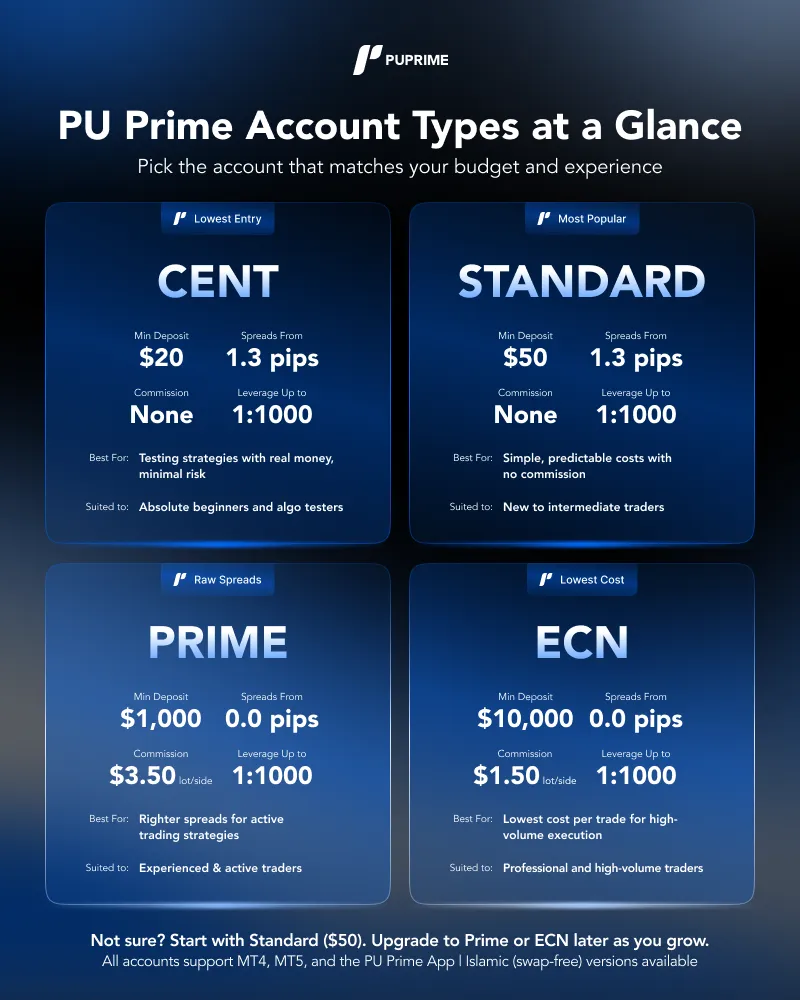
With PU Prime, the minimum deposit is $50, and you can trade micro lots — so you can start small and scale up as you improve.
One more thing: never fund a trading account with rent money, bill money, or savings, because you’ll panic when you lose.
Treat your trading capital the same way you would treat money spent on a course or a gym membership.
If it goes to zero while you are learning, it should not create a financial crisis in your life.
How to Start Forex Trading: Step by Step
Starting forex trading involves five steps: learning core concepts, choosing a broker, opening a demo account, building a trading plan, and then moving to a live account when you are ready.
Let me walk through each one.
Step 1: Learn the Core Concepts
Before you touch a trading platform, you need to understand a handful of terms that come up constantly. You do not need a finance degree. You just need to know what these words mean in plain English:
Currency pair: Two currencies quoted together, like EUR/USD. The first is the “base”, and the second is the “quote.” The price tells you how much of the quote currency you need to buy one unit of the base.
Pip: The smallest standard price movement in a pair. For most pairs, it is the fourth decimal place. If EUR/USD moves from 1.1050 to 1.1051, that is one pip.
Lot size: How much currency are you trading? A standard lot is 100,000 units. A mini lot is 10,000. A micro lot is 1,000. Beginners should trade micro lots.
Leverage: Borrowed buying power from your broker. With 1:100 leverage, your $100 controls $10,000. This amplifies both gains and losses — so treat it carefully.
Spread: The tiny difference between the buy price and the sell price. This is how most brokers make money. Tighter spreads mean lower trading costs for you.
Stop-loss: An automatic order that closes your trade if the price moves against you by a set amount. It is your safety net. Always use one.
If you want a deeper dive into how these concepts work in practice, the CFD trading guide covers mechanics in detail.
Forex is traded through CFDs (Contracts for Difference) at most retail brokers, so understanding how CFDs work gives you a stronger foundation.
Step 2: Choose a Regulated Broker
Your broker is the company that gives you access to the forex market.
Choosing the right one matters more than most beginners realise.
The single most important thing to check is regulation.
A regulated broker must follow the rules set by a financial authority.
These rules protect your money and make sure the broker operates fairly.
Some of the most respected regulators include the FCA (United Kingdom), ASIC (Australia), and the FSA (Seychelles).
After the regulation, compare these things:
Minimum deposit: How much do you need to start? Some brokers ask for $200 or more. Others, like PU Prime, let you start with $50.
Spreads and commissions: How much does each trade cost you? Lower is better.
Trading platform: MetaTrader 5 (MT5) is the industry standard. Make sure your broker supports it.
Account types: Some brokers offer accounts tailored to different experience levels. Check what account types are available, so you can pick the right one for where you are right now.
Deposit and withdrawal methods: Can you easily fund your account and withdraw funds? Check the options before you sign up.
Do not rush this step. Spend an afternoon comparing two or three brokers. Read their fee schedules. Check whether they offer a demo account.
Look for independent reviews from other traders. The 15 minutes you spend researching could save you real money later.
Step 3: Open a Demo Account and Practise
A demo account is a practice account that uses fake money but connects to real, live market prices. It is the single best tool a beginner has.
When you open a demo account, you will usually get somewhere between $10,000 and $100,000 in virtual money. You can place trades, test strategies, make mistakes — and none of it costs you a cent. The platform looks and works exactly the same as the live version.
Here is what to focus on during your demo phase:
Get comfortable with the platform. Learn how to open and close trades, set stop-losses, and read a price chart. The MetaTrader 5 guide walks you through the basics if you need help.
Trade one or two pairs only. EUR/USD and GBP/USD are the most popular and most liquid. Stick with these until you feel confident.
Track your trades in a journal. Write down why you entered, where your stop-loss was, what happened, and what you learned. This habit separates serious traders from gamblers.
Spend at least 2–4 weeks on demo before going live. There is no prize for rushing. The market will still be there next month.
One honest warning about demo trading: it does not feel the same as real trading.
When fake money is at stake, you will take risks you would never take with real cash.
That is fine with learning the platform.
But do not assume your demo results will transfer perfectly to a live account.
The emotional pressure of real money changes everything.
Step 4: Build a Simple Trading Plan
A trading plan is a set of rules you write down before you start trading with real money. It does not need to be complicated. Even a half-page plan is better than no plan at all.
Your plan should answer these questions:
What pairs will I trade? Start with one or two major pairs.
What time of day will I trade? The forex market runs 24 hours a day, but not all hours are equal. The London and New York sessions (roughly 8 am‒5 pm GMT and 1 pm–9 pm GMT) tend to have the most movement.
How much will I risk per trade? Stick to 1–2% of your account. If you have $200, that means risking no more than $2–$4 per trade.
What will trigger me to enter a trade? Write down specific conditions. “I will buy when the price breaks above the previous high with rising volume” is a plan. “I think it looks like it’s going up” is a guess.
When will I exit? Know your stop-loss and your profit target before you click “buy” or “sell.”
If you are not sure where to begin with strategies, the trading strategies guide breaks down several approaches that work for beginners.
The key is picking one method and sticking with it long enough to learn from it — not jumping between five different strategies every week.
Step 5: Go Live — But Start Small
Once you have practised on the demo, built a plan, and feel reasonably comfortable with the platform, you are ready to open a live trading account.
But please, start small.
Fund your account with the minimum amount you are comfortable losing.
With PU Prime, that can be as low as $50.
Trade micro lots. Use low leverage.
Treat the first few months of live trading the same way you treated the demo phase — as a learning exercise, not a money-making exercise.
Something strange happens when real money is on the line.
You will feel fear when a trade goes against you.
You will feel greed when a trade is winning, and you want more.
You will be tempted to move your stop-loss, to hold losing trades too long, or to overtrade after a loss.
Every single beginner goes through this.
This is why starting small protects you.
A $2 loss teaches you the same lesson as a $200 loss — but it does not wreck your account in the process.
What Are the Biggest Mistakes Beginners Make?
The most common beginner mistakes are using too much leverage, trading without a stop-loss, and making emotional decisions after a loss.
I could list twenty mistakes, but honestly, most of them come down to the same root cause: impatience.
New traders want results fast.
That impatience leads them to:
Overleveraging. Just because you can use 1:500 leverage does not mean you should. High leverage on a small account is the fastest way to blow it up. Start at 1:10 or 1:20, and keep going until you get consistent results.
Skipping the demo phase. Some people deposit money on day one and start trading without knowing how to read a chart. This is like driving without a lesson.
Revenge trading. You lose a trade, feel frustrated, and immediately jump back in to “win it back.” This almost always leads to bigger losses.
No stop-loss. Trading without a stop-loss is like driving without a seatbelt. It feels fine until the one time it really matters.
Jumping between strategies. A strategy needs dozens of trades to prove itself. Switching after three losses does not give any method a fair chance.
Ignoring the news. Major economic announcements (interest rate decisions, employment data, GDP reports) can cause massive price swings in seconds. Know when they are coming and either trade around them or sit out.
Here is the uncomfortable truth that most trading websites will not tell you: between 70% and 80% of retail CFD traders lose money.
That number is derived from regulatory disclosures required by the FCA and the ESMA.
It does not mean forex is a scam. It means most people are unprepared, undercapitalised, or too impatient.
The people who succeed treat trading like a skill that takes months or years to develop, not a lottery ticket.
Do You Need Experience to Trade Forex?
No. Anyone can learn forex trading, but it requires patience, practice, and a willingness to lose small amounts of money while you figure things out.
You do not need a background in finance.
You do not need to understand advanced mathematics.
The core skills you need are pattern recognition (looking at price charts), discipline (following your plan), and risk management (protecting your money).
Some beginners find it helpful to follow experienced traders while they learn.
Copy trading lets you automatically replicate the trades of a more experienced trader.
It is not a substitute for learning — but it can give you a front-row seat to see how profitable traders think and act.
With PU Prime, you can start copy trading with as little as $25 per signal provider.
Whether you learn by yourself or with help, the path is the same: study, practise on demo, go live with small amounts, and keep a journal. There is no shortcut.
Which Currency Pairs Should a Beginner Trade First?
Beginners should start with the major currency pairs — EUR/USD, GBP/USD, and USD/JPY — because they have the tightest spreads, the most liquidity, and the most predictable behaviour.
Major pairs involve the US dollar paired with another widely traded currency.
They make up the bulk of daily forex volume, which means prices tend to move more smoothly.
The spreads (your cost per trade) are also lowest on these pairs, which helps when you are trading small amounts.
Avoid exotic pairs (like USD/TRY or EUR/ZAR) when you are starting out.
They have wider spreads, wider price swings, and less predictable behaviour.
Save them for when you have more screen time and experience.
A good approach to your first month: trade only EUR/USD.
Learn how it moves, what drives it, and how it reacts to news events.
Mastering one pair deeply will teach you more than dabbling in ten pairs at once.
Frequently Asked Questions
Is $100 enough to start forex trading?
Yes. Many brokers accept deposits of $100 or less. PU Prime lets you start with $50. The key is using micro lots and keeping your risk per trade at 1–2% of your balance.
With $100, that means risking $1–$2 per trade. You will not get rich this way, but you will learn the mechanics of live trading without taking on serious financial risk.
Can I learn forex trading on my own?
Absolutely. Most successful retail traders are self-taught. Between free broker education, YouTube tutorials, demo accounts, and trading communities on Reddit and forums, you have more free learning resources today than at any point in history.
The only thing money buys you is speed — a paid course might organize the information better, but the same information is out there for free.
How long does it take to become profitable in forex?
There is no fixed timeline. Some people find consistency within six months. Others take a year or more. A small percentage never gets there.
The factor that separates the two groups is not intelligence — it is discipline and risk management.
If you can follow your own rules and accept small losses calmly, you are ahead of most beginners.
Is forex trading risky?
Yes. All leveraged trading involves significant risk, and you can lose more than your initial deposit if you are not careful. Between 70% and 80% of retail CFD traders lose money, according to data consistent with ESMA and FCA disclosures.
The risk is manageable if you use stop-losses, trade small positions, and never risk money you cannot afford to lose. But the risk is always there.
What is the difference between forex and CFD trading?
Most retail forex trading happens through CFDs (Contracts for Difference). When you trade a CFD, you are speculating on price movements without actually owning the currency.
CFDs also let you trade other markets, such as indices, commodities, and stocks, from the same account. The CFD trading guide explains this in more detail.
Should I use a demo account or go straight to live trading?
Always start with a demo account.
Spend at least two to four weeks on it. Learn the platform, test a strategy, and make your early mistakes with virtual money.
When you switch to live, start with the smallest possible position size. The transition from demo to live is the hardest part of becoming a trader because your emotions suddenly become a factor.
Start trading with an edge today
Trade forex, indices, metal, and more at industry-low spreads and lightning-fast execution.
Start trading with deposits as low as $50 on our standard accounts.
Get access to 24/7 support.
Access hundreds of instruments, free educational tools, and some of the best promotions around.
Important Notice: Please note the Website is intended for individuals residing in jurisdictions where accessing the Website is permitted by law.
Please note that PU Prime and its affiliated entities are neither established nor operating in your home jurisdiction.
By clicking the "Acknowledge" button, you confirm that you are entering this website solely on your own initiative and not as a result of any specific marketing outreach. You wish to obtain information from this website which is provided on a reverse solicitation basis in accordance with the laws of your home jurisdiction.
Please note the Website is intended for individuals residing in jurisdictions where accessing the Website is permitted by law.
Please note that PU Prime and its affiliated entities are neither established nor operating in your home jurisdiction.
By clicking the "Acknowledge" button, you confirm that you are entering this website solely based on your initiative and not as a result of any specific marketing outreach. You wish to obtain information from this website which is provided on reverse solicitation in accordance with the laws of your home jurisdiction.
Ten en cuenta que el sitio web está destinado a personas que residen en jurisdicciones donde el acceso al sitio web está permitido por la ley.
Ten en cuenta que PU Prime y sus entidades afiliadas no están establecidas ni operan en tu jurisdicción de origen.
Al hacer clic en el botón "Aceptar", confirmas que estás ingresando a este sitio web por tu propia iniciativa y no como resultado de ningún esfuerzo de marketing específico. Deseas obtener información de este sitio web que se proporciona mediante solicitud inversa de acuerdo con las leyes de tu jurisdicción de origen.